Por: Alejandro Umaña Rojas
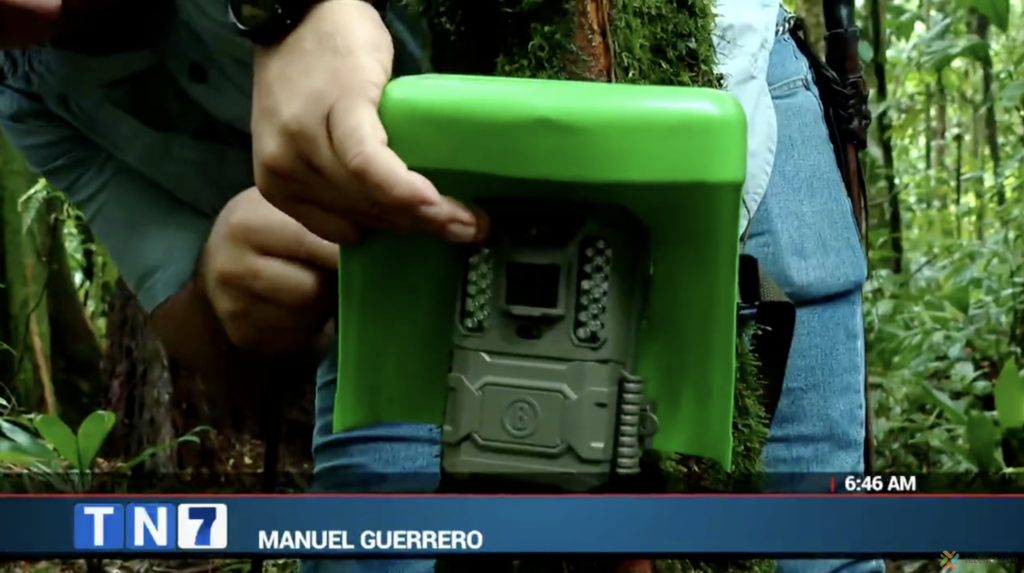
Camera traps: how the "eyes" that reveal wildlife in Costa Rican forests work
Thanks to technology, it is now possible to confirm the presence of animals such as jaguars, tapirs, or deer in the forests without disturbing their environment. This is achieved through the use of camera traps, devices that allow for the discreet recording of wildlife.
In forests like those of the Braulio Carrillo National Park, scenes occur that have rarely been observed by humans. Some species leave tracks in the mud; others hide among leaves and branches..
Tapirs, coyotes, and deer—animals ranging from the largest to the smallest—are part of those scenes that only technology has managed to capture. There have even been recordings of behaviors such as jaguar reproduction or predation between species.
Monitoring in forests near Braulio Carrillo
To see how these cameras work, a team traveled to La Virgen de Sarapiquí, where a forest serves as a buffer zone between the national park and nearby cattle farms.
At this site, the organization FUNDECOR maintains a wildlife monitoring program. As part of the project, it distributes between eight and ten camera traps across each farm.
This is how the cameras are installed
To select the ideal spot within the forest, researchers analyze animal transit routes.
The cameras are placed approximately 50 centimeters from the ground and secured against a tree trunk. The lens is oriented toward the area where wildlife transit is expected, at a distance of about three meters.
Additionally, the devices are programmed to record only animal movement, preventing the memory from filling up with unnecessary images.
Weeks of waiting in the forest
Once installed and turned on, all that's left is to wait.
La batería de estas cámaras puede durar entre tres y seis semanas. Tras ese periodo, los investigadores regresan al bosque y, con ayuda de un GPS, localizan nuevamente cada dispositivo. Luego extraen la tarjeta de memoria y revisan en una computadora todo lo que haya ocurrido frente al lente durante ese tiempo.
Beyond wildlife: trees are also studied
Monitoring on these farms near Braulio Carrillo is not limited to animals. In the same location, tree growth is also evaluated. To do this, researchers measure the circumference of each trunk, an indicator that allows them to estimate their age.
Each tree is identified with a tag, and the information is recorded in an app. The study area corresponds to a plot of 30 by 100 meters, which is approximately 0.3 hectares.
The utility of these studies—both the images captured by the camera traps and the data on tree growth—will be addressed in a future installment.

Copyright © 2026 FUNDECOR. All rights reserved.